Inference
Serve the model where the data is allowed to be
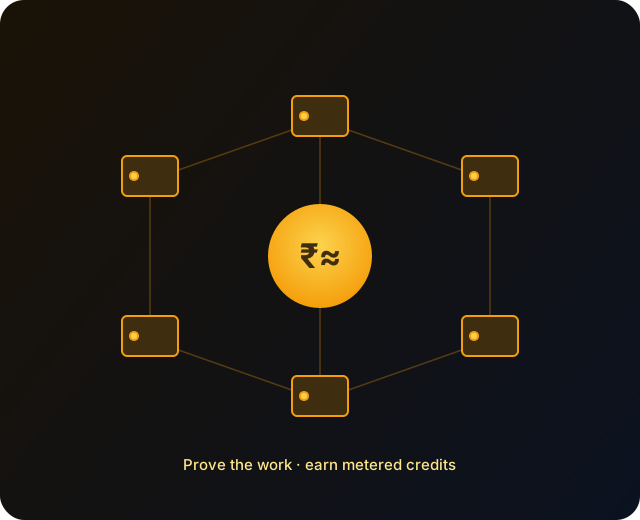
Most inference decisions are really placement decisions. 50GRAMx lets you move the model to the data instead of the data to the model — on the device, or inside your own walls — with the same signed meter running underneath both.
Why placement is the whole problem
Latency is the easy part. What actually blocks an inference deployment is where the data is allowed to go, whether the model can really do the job, and whether the bill can be checked.
The data can’t leave
The inference that matters most runs on the records you are contractually forbidden to send anywhere — patient notes, ledgers, case files. A public endpoint is not an option, so that work simply never gets done.
The model was never measured
Model choice is made from a vendor’s benchmark table. Nobody re-ran it on the hardware you will actually serve from, at the context length you will actually use. A model that passes a demo can fail the real task.
The meter can’t be audited
You are billed per token by a counter you cannot inspect, running on a machine you cannot identify. When the invoice looks wrong, there is nothing to check it against.
A spectrum of control
The same workload, the same meter, and the question that decides everything: whose machine is this? You pick per workload, and you can move a workload inward when the rules tighten. The third answer is on this page because it is honest, not because it is available.
On the device
The model runs on the machine in front of you. Nothing leaves. Nothing is metered, because nothing was spent that you did not already own.
Free
Inside your gram
The workstations and servers your organisation already owns, pooled under your own certificate authority. Egress is topology-locked to your network, so the data stays inside your perimeter.
Free — it is your hardware
On a stranger’s machine
This does not run. When a model is larger than your gram can serve, there is today no way to buy a few minutes of someone else’s hardware and have it prove what it did. Building that is the work; claiming it is finished would be the lie.
Not available
Don’t trust the model card. Verify the model.
Choosing where to serve is half the decision. The other half is choosing what to serve — and that choice should rest on a measurement someone signed, not on a table in a launch post.
Measured, not declared
A node advertises what it can run; the platform makes it prove that by challenge before it is allowed to serve. Declared capability and measured capability are stored as separate fields, and the router only trusts the measured one.
Routed on evidence
Model selection reads a matrix of benchmark results — context window, tool use, vision — measured on real hardware, signed by the node that ran the benchmark. Your workload is matched to what a model has demonstrably done, not to what its card claims.
A receipt per unit of work
Each unit of work is metered and signed by the node that performed it. Which node, which model, what it cost — priced in a stable unit, on one ledger the whole platform shares.
What the models proved
Every figure below was measured by a node running the model, and signed by that node. There is no column for what a model card claims, because nobody signs a model card.
Context proved by recall
4,096tokens
did:epn:002408…9e3c79 · Jul 10, 2026
Fastest measured
6.91tokens/s
did:epn:002408…9e3c79 · Jul 10, 2026
Declared 131,072 tokens of context; a machine here proved 4,096. See every machine →
Capabilities, measured
Tool calling — passed
The node asked the model to call a function and checked whether it produced a valid call. Passing here is not the same as reasoning correctly over what the tools returned — a smaller model can do the first and fail the second silently.
Tool loop finished — passed
Whether the conversation ENDED after the tool call, or the model kept calling until the turn budget ran out. Passing “tool calling” and failing this means the model will call a tool in production and never come back. A model chosen on the first flag alone is the reason an agent silently stops delivering work.
Vision — passed
Shown an image and asked what was in it. The node checked the answer.
Audio — probed, and failed
Given audio and asked to transcribe it.
Extended thinking — probed, and failed
The model emits reasoning before its answer. Measured where the probe could observe it.
Structured output — passed
Asked for JSON matching a schema, and got it. This is the difference between a model you can build on and one you must parse defensively.
Context proved by recall
4,096tokens
did:epn:002408…9e3c79 · Jul 10, 2026
Fastest measured
7.79tokens/s
did:epn:002408…9e3c79 · Jul 10, 2026
Declared 131,072 tokens of context; a machine here proved 4,096. See every machine →
Capabilities, measured
Tool calling — probed, and failed
The node asked the model to call a function and checked whether it produced a valid call. Passing here is not the same as reasoning correctly over what the tools returned — a smaller model can do the first and fail the second silently.
Tool loop finished — probed, and failed
Whether the conversation ENDED after the tool call, or the model kept calling until the turn budget ran out. Passing “tool calling” and failing this means the model will call a tool in production and never come back. A model chosen on the first flag alone is the reason an agent silently stops delivering work.
Vision — probed, and failed
Shown an image and asked what was in it. The node checked the answer.
Audio — probed, and failed
Given audio and asked to transcribe it.
Extended thinking — probed, and failed
The model emits reasoning before its answer. Measured where the probe could observe it.
Structured output — passed
Asked for JSON matching a schema, and got it. This is the difference between a model you can build on and one you must parse defensively.
Context proved by recall
4,096tokens
did:epn:002408…9e3c79 · Jul 10, 2026
Fastest measured
16.71tokens/s
did:epn:002408…9e3c79 · Jul 10, 2026
Declared 40,960 tokens of context; a machine here proved 4,096. See every machine →
Capabilities, measured
Tool calling — passed
The node asked the model to call a function and checked whether it produced a valid call. Passing here is not the same as reasoning correctly over what the tools returned — a smaller model can do the first and fail the second silently.
Tool loop finished — probed, and failed
Whether the conversation ENDED after the tool call, or the model kept calling until the turn budget ran out. Passing “tool calling” and failing this means the model will call a tool in production and never come back. A model chosen on the first flag alone is the reason an agent silently stops delivering work.
Vision — probed, and failed
Shown an image and asked what was in it. The node checked the answer.
Audio — probed, and failed
Given audio and asked to transcribe it.
Extended thinking — probed, and failed
The model emits reasoning before its answer. Measured where the probe could observe it.
Structured output — passed
Asked for JSON matching a schema, and got it. This is the difference between a model you can build on and one you must parse defensively.
Context proved by recall
Not probed. No node has yet shown this model recalling a token from the far end of its context, so we publish no length for it.
Fastest measured
27.23tokens/s
did:epn:002408…9e3c79 · Jul 10, 2026
Capabilities, measured
Tool calling — probed, and failed
The node asked the model to call a function and checked whether it produced a valid call. Passing here is not the same as reasoning correctly over what the tools returned — a smaller model can do the first and fail the second silently.
Tool loop finished — probed, and failed
Whether the conversation ENDED after the tool call, or the model kept calling until the turn budget ran out. Passing “tool calling” and failing this means the model will call a tool in production and never come back. A model chosen on the first flag alone is the reason an agent silently stops delivering work.
Vision — probed, and failed
Shown an image and asked what was in it. The node checked the answer.
Audio — probed, and failed
Given audio and asked to transcribe it.
Extended thinking — probed, and failed
The model emits reasoning before its answer. Measured where the probe could observe it.
Structured output — probed, and failed
Asked for JSON matching a schema, and got it. This is the difference between a model you can build on and one you must parse defensively.
What we rejected
Nothing. Every model measurement offered to the network verified against the signature of the node that produced it. One that does not is excluded from every number above and listed here instead.
every field verified against the signature of the node that produced it; effective_ctx is the context length a node PROVED by recall, never the length a model card advertises.
Published 2026-07-10T04:59:16.445Z
Where this stands today
Inference on your own devices, and across a gram of machines you own, runs today — and every unit of work is metered and signed on the ledger. Buying capacity from a stranger’s machine does not run, and we will not describe it as finished before it is. We do not operate a managed training fleet, we do not run a 24/7 operations centre, and we will not quote you a throughput number that nobody here has measured. When a claim on this page becomes checkable, it goes on the proof page with the signature attached.
See what we can already prove →